Great Decisions 1965; 3; Trade, Food and Dollars: What Policies for the US?
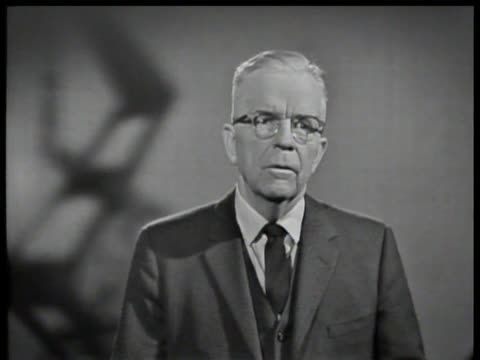
- Transcript
because at the national educational television network it is twenty years that the world war two also defeated and the nations of the law that a nonprofit the past countries of the world trade with each other by from each other afterwards each other technology has brought these machines low cost per unit of production of cheap mass consumer products
and there is another tooth good evening i'm don goddard decision series is presented in connection with the discussion program being conducted around the country by the foreign policy association in cooperation with hundreds of local organizations tonight one of the most complex where most important far ranging of all topics trade food and dollars our commentator an analyst with a former assistant secretary of state
law professor of government at columbia university writer hilton at the river then he emerge and prosperity in the world today is the development of world trade today world trade stands at a critical juncture in geneva their candy round of tough negotiations is underway the trade expansion act passed by the us congress in nineteen sixty two with the strong support of president kennedy spurred these negotiations into reality through them our government is doing some hard bargaining with sixty odd other nations which was an instrument for these negotiations is that the general agreement on tariffs and tray why should a macro lot more trade especially with other developed nations when we produce so much write your goal no trade and reciprocal tariffs were down what economists call comparative advantage and specialization a function that example rescue only
produces small cars are united states produces better crops and as we buy more oil cartons they buy more show it the theory is that in the long run increased world trade will benefit everybody but this is lord keynes once remarked in the long run we'll also all be dead politicians and concerned citizens are often afraid of what parrott negotiations will do in the short run from our and the immediate hardships of change changing industries change of jobs for individual workers shade of technologies are a real hot with trading bloc's with increased world trade the developed countries of the world are richer today than they've ever been and they will pony is after world war two europeans returned if at all by its prosperity and our best reserve an increased production continues to
rise i think that in nineteen forty five wasted and destroyed factories an economy long haul shattered my mom thank you built on this economic recovery think
blast from an american point of view of a great trading market in which americans as well as europeans can buy and sell once the momentum has been established prosperity bills itself as a longshoreman that the only american to profit by trade so the kansas farmers one fifth of their harvest goes oversee these men are inspecting machine so far nations american consumers know it was joyous in it the united states is the world's greatest trading nation we sell twenty eight billion dollars worth of goods overseas to europe and the common market buys twenty three billion in nineteen fifty eight the common market was established with america's strong support six countries france west
germany italy belgium the netherlands and luxembourg began the construction of a tariff free economic union expected to be completed in nineteen seventy prosperity will bring us a greater market by nineteen sixty four common market countries have already recused internal tariffs by sixty percent rate among member states more than doubled between nineteen fifty eight nineteen sixty three imports from outside countries increased by his research the figures tell only the outlines of the story on the hard bargaining a potential this allocation in certain countries what kind of hardship will this one french week flows into italy and france with its letters so i was able to produce wheat more cheaply than italy or germany you know others face hardship and farmers will prosper
running those i'm not just between common market members of united states is also profoundly affect a regionally important role we're now entering a new era of economic and financial independence the rise of trading likely to become a moderate offers new image on the trade liberalization united states has prepared itself to take advantage of those opportunities by legislating by legislation permitting occasionally and trade barriers the county around apparently go see asians is now under way in geneva have brought about largely through the inspiration of our way president or had some of the problems been in transatlantic trade and these are chickens innocent victims of nineteen sixty twos chicken war between germany india because of technology the us has been able to hack and grow chickens in greater
abundance than europe so far germany afraid to the prosperity it's chicken farmers in nineteen sixty two increased its tariffs on imported chickens from five to over thirteen cents a farm the us retaliated raising its tariffs and legal moment certain items produced by germany the lesson that fight terrorist ring retaliation has not been lost on european nations are indeed our own policy makers americans often worry about the effects of low taxes we fear the cheaper labor in other nations will displace american workers and deprive us of our prosperity today japan is hardly the cheap labor camp it was for ten years ago when so many americans were less expensive japanese products japan and later provided the basis for building modern industrial with modernization and increased efficiency japan was able to compete more effectively in the international market depends trade with us as always
remained at a deficit or archie has been able to sell more and more to asian countries and to create a total trade surplus favorable to her as trade flows sort of gigi is behind the growth in world trade lies these machines is low cost per unit of production not necessarily cheaper labor which brings deeper problems and more trade as beakman in geneva then the kennedy round of care negotiations is underway to discuss these negotiations with writer hilton is the deputy assistant secretary of state a specialist in
international trade and the author of the recently published book in pursuit of world order richard and guard mr gardner in your new book to discuss the problems of the economy round what does the united states hoping dogs essentially two things first we seek to promote the economic growth and prosperity of the american people and other countries in whose welfare we have an important stake and secondly we seek to advance the political unity of the north atlantic community and of the entire non communist world we seek to do this through an unprecedented cutting of types of up to fifty percent across the board with just a few items are held out of the negotiations before special reasons of national security
and national interest with your face get out of this improves the world but in terms of our economic prosperity i think if it means how it will mean for the american house sweig to be specific better and cheaper products that will mean a sign for house was originally comparative advantage that's right now about the obstacles what stands in our way of accomplishing his goals well one major problem in this negotiation is our relationship with the european economic community the common market as we all recognize the common market countries are moving rapidly to establish a customs union that is to say they are illuminating and the cavs among themselves while a rectory a common cab and for the outside world and also at the end of this transitional period producers within the common market will have access to that market
which is much more favorable to producers in the united states the united kingdom and other non participating countries of the problem is to bargain down the external terror for the common market in such a way as to minimize the discrimination against producers in the united states and elsewhere and it's you all really anticipate much dislocation year much less major say re train workers yes we do and one of the novel aspects of the trade expansion act which is the us instrument for but as a patient in the kennedy round is that it provides for the first time in american history adjustment assistance to workers and producers who have to adjust to new lines and more competitive lines of production as a result of these tariff cuts the principle obstacle to success it appears is the agricultural problem the common market is becoming increasingly self
sufficient or as of our culture in terms of the committee and the europeans have negotiated a chicken or have achieved an agricultural revolution similar to the one we've achieved they're becoming more self sufficient and they are erecting barriers toward our farm products will and that we have got to get assurances of access to this rapid withdrawal goes on here in geneva the problems of the rich are indeed complex it seems evident that we all drive a hard bargain and that we have the west are rich on training skills technology indeed ideas and ideals of their money or not it is the height of irony that the technological revolution which has the last fifteen years begun to revolutionize agriculture of developed countries as only partially effective economies
illustrative in country can not in this day of modern technology be dependent on one commodity or even any variety of raw materials give it is to prosper having a rubber tree is a relatively simple task robert can begin to provide the basis of economic prosperity but robert what the price really on the international market and if it has to sell one reason that in an easier with her important rubber plantations has encountered the world is that more than half of the robber used in the world today is not natural it is encouraging so many of
them god industrialization is different for a number of reasons it would not be worthwhile forgotten to develop the dairy industry forest land or granite tomb was july in this area not on manufacturing but ongoing are all commodity in because the bands and affiliation those not come overnight many of the developing nations the land portrayed again not just in brazil but in many african countries to forcing down the price of oil producing countries off and got a commodity agreement would rise of coffee in the world money
the difficulty is how to get started how does a developing nation began on the path to prosperity in the proper foundations for economic development and at the very time that get inaugurated the kennedy around in may nineteen sixty four it had to share the spotlight with another meeting on world trade also held in geneva that it was the united nations conference on trade and development a spokesman un secretary general and tide as it came to be called was an argentinean that parole probation simple purpose of on todd was to find a way to bridge the growing gap between imports and exports of those lesser developed countries it is in the interests of neither the developed are the lesser developed nations on the lesser developed
countries have economies and capable of generating good services and money they can buy even more primitive organisms they can buy more unless they have money foreign aid must only be a temporary situation they cannot get money unless they can sell wireless they get to date twenty years of the world war two these countries are becoming relatively less capable of buying from and selling to us between nineteen fifty in nineteen sixty a lesser developed countries arab world trade problem thirty twenty percent when they're pressing population problems and they're frequently unstable political system is the less developed nations aren't some opposition of the queen in alice in wonderland witness work ever harder a state judge cheap labor can revive the hubbell trading places need to have the right industry
but it is difficult to compete against developed nations where there's a barrier mccain's which bring more costly unit of production the fight is one country have another does not why are the products of the machine distributed so abundantly from less than one third of the world's people and the state department all of the remaining hundreds of millions with the trade gap go its consequences are easier to describe the instrument is growing danger particularly painful for the world's most developed nations when the golden very difficult and very slight thank you
some of them and so what can be done about closing the gap between the haves and i have not with us tonight is a man who has one answer to discuss his approach with roger bolton and richard gardner is the widely respected argentinian economy is secretary general of the united nations conference on trade and development dr rowe ph dr behravesh we've seen the film and it happens in which your secretary general what results do you expect to come out of this one is it that beginning off a very long process but i think it is a very fortunate beginning because the controllers path out out at a restaurant and much better understanding of the problems of the developing countries you know that approximately the week before it is not the necessary
indispensable to think in the nomination but at the same time is necessary to promote trade why because it is a well known fact that development in nate's higher and higher and four and developing countries can not pay these higher import wheat exports off primary commodities was a half get new sources of foreign income for the development of new ones specially picked lot of money and he misses an underground a half to have some sort of here and you think this is where the the more developed nations and dr corell interest in countries said need to export more intellectually impaired more uses only way of luck charm of technology i know that mr gardner has
some news on this particular mission to their well i think all of this came away from this most important and historic conference in geneva with a sense of the two sided nature of the problem on the one hand as dr privilege quite rightly points out the developed countries have got to do more to open their markets to the exports of the less developed countries and toward a transfer skills and know how and capital to help these countries the same time the less developed countries can do much more internally to create the preconditions for competitive exports what is going to bring about takeoff i have been concerned for example if the philippines seems to me that they have an approved requisites for further development for a somewhat more rust colored called take off into a nationalization what you think are the prerequisites of any of these emerging countries on this well i think that
i'm on the mall or quit because i'm sorry to introduce this is all still show her home morphed into economic and social structure of the piece the minute then what about the end game into a male active and vigorous international coalition with another he was over there the tax refunds and encourage investment within the country as well as an investment company outside yes yes it does more significant point of view of this in town a reform aimed at expanding economy doesn't incarnations of expanding trade and does this we have a relationship with that with the work that is going to be the economic efforts in the developed countries and the other developed countries try and you know serves expanding trade more capital that they know it's a relationship is there
between that was just the beginning of our enterprise i hope but relations would be a very good thing coming back to this the internal problems of the developing countries which we in washington say is quite central to this enterprise i wonder if dr beveridge would agree that even if the developed countries do their share remove the obstacles to the exploits of the developing countries that much has to be done within the developing countries themselves to help themselves land reform tax reform realistic rates of foreign exchange some attempt to curb this rapid population growth which threatens to swamp all economic plans available to train managerial class stimulus to competitive enterprise isn't all of this the other side of the coin that has to go with action on the trade front i can of it more with you but all of this should be a part of a program
where they don't know the measure up to play a valuable bubble exterminators without internal reforms would be on their little meaning or intent of reform without a better place of economic cooperation would be lost so since the geneva conference was a great dialogue that was startling between the developed countries on one side of the developing countries to assume their shared responsibilities in dealing with what is necessarily a two sided that's arkansas not not only that i considered about is that of the uk not encourage clean shaven nation's between the forest of snark a group of latin americans are working to persuade latin american countries to give more impetus for the free trade area we were sparked by reducing do this and more in developing countries of latin america
mm hmm after golfing coaching with this what is your assessment of the chances of getting the kind of widespread agreement it looks like a pretty big task when you think the gap and tax reductions and the domestic problems in every country that just produces the task of with iranian the underdeveloped countries the task of external aid and investment from the country's major assessment new optimistic about now i would change is if i would not believe in the powers authorization when when we have to defend with ivf i when i saw that is cutting those i believe in a revolution of rising demand sweeps the world's peoples and yet the relative position of the underdeveloped countries does not get better politically hunger breeds
only the twin evils of dictatorship or communism economically when the poor don't become rich they become a bigger market for us and we are bigger market for them but how do they get richer i was brought to america by next week with is don goddard good evening this week but i
chose is beneath the the national educational television network
- Series
- Great Decisions 1965
- Episode Number
- 3
- Producing Organization
- WNDT (Television station : Newark, N.J.)
- Contributing Organization
- Library of Congress (Washington, District of Columbia)
- AAPB ID
- cpb-aacip/512-dz02z13p16
- NOLA Code
- GRTC
If you have more information about this item than what is given here, or if you have concerns about this record, we want to know! Contact us, indicating the AAPB ID (cpb-aacip/512-dz02z13p16).
- Description
- Other Description
- The series of eight half-hour episodes, featuring distinguished foreign policy experts and observers, consists of topics corresponding to those chosen by the Foreign policy Associations annual nationwide discussion program. The issues to be examined are Red China, Germany, Trade, South Africa, Eastern Europe, the United Nations, Vietnam, and the population problem. Roger Hilsman, former Assistant Secretary of State, who is now professor of government at Columbia University, moderates Great Decision 1965. Don Goddard, noted broadcasting reporter, is the narrator. Great Decisions 1965 is being produced for National Educational Television by WNDT, New York Citys educational television station. The 8 episodes that comprise this series were originally recorded on videotape. (Description adapted from documents in the NET Microfiche)
- Broadcast Date
- 1965-00-00
- Asset type
- Episode
- Genres
- Talk Show
- Topics
- Global Affairs
- Public Affairs
- Media type
- Moving Image
- Duration
- 00:29:55
- Credits
-
-
Host:
Hilsman, Roger
Producer: Lukas, Christopher
Producer: Krosney, Herbert
Producing Organization: WNDT (Television station : Newark, N.J.)
- AAPB Contributor Holdings
-
Library of Congress
Identifier: 2080238-2 (MAVIS Item ID)
Format: 1 inch videotape: SMPTE Type C
Generation: Master
Color: B&W
Duration: 0:28:50
-
Library of Congress
Identifier: 2080238-1 (MAVIS Item ID)
Format: 2 inch videotape
Generation: Master
Color: B&W
Duration: 0:28:50
-
Library of Congress
Identifier: 2080238-3 (MAVIS Item ID)
Format: U-matic
Generation: Copy: Access
Color: B&W
Duration: 0:28:50
-
Library of Congress
Identifier: 2080238-5 (MAVIS Item ID)
Generation: Copy: Access
Color: Color
-
Library of Congress
Identifier: 2080238-4 (MAVIS Item ID)
Generation: Master
Color: Color
If you have a copy of this asset and would like us to add it to our catalog, please contact us.
- Citations
- Chicago: “Great Decisions 1965; 3; Trade, Food and Dollars: What Policies for the US?,” 1965-00-00, Library of Congress, American Archive of Public Broadcasting (GBH and the Library of Congress), Boston, MA and Washington, DC, accessed October 13, 2026, http://americanarchive.org/catalog/cpb-aacip-512-dz02z13p16.
- MLA: “Great Decisions 1965; 3; Trade, Food and Dollars: What Policies for the US?.” 1965-00-00. Library of Congress, American Archive of Public Broadcasting (GBH and the Library of Congress), Boston, MA and Washington, DC. Web. October 13, 2026. <http://americanarchive.org/catalog/cpb-aacip-512-dz02z13p16>.
- APA: Great Decisions 1965; 3; Trade, Food and Dollars: What Policies for the US?. Boston, MA: Library of Congress, American Archive of Public Broadcasting (GBH and the Library of Congress), Boston, MA and Washington, DC. Retrieved from http://americanarchive.org/catalog/cpb-aacip-512-dz02z13p16